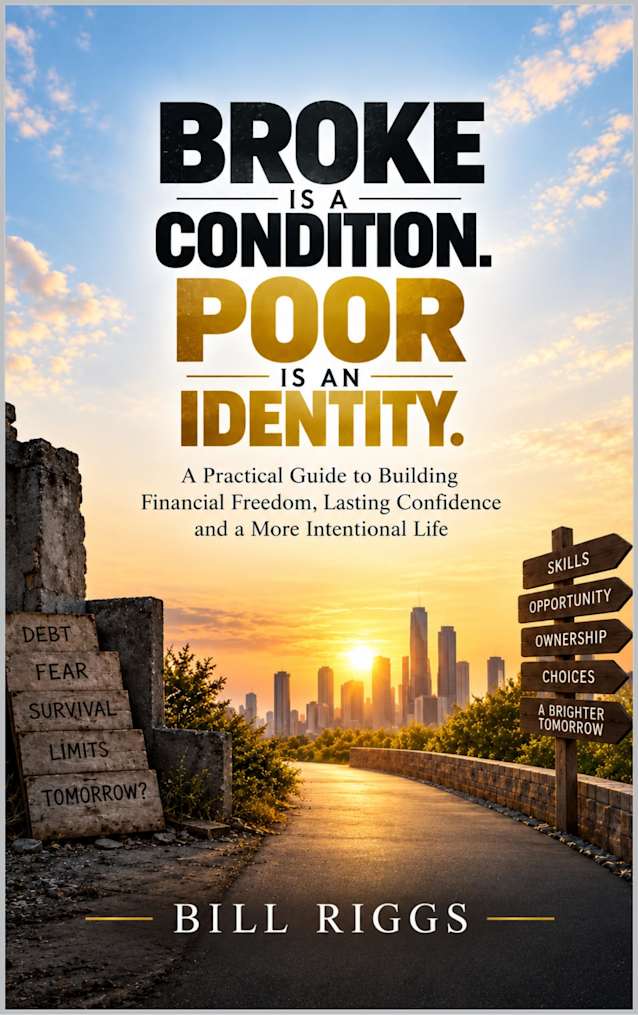
Broke Is a Condition. Poor Is an Identity
About
Broke Is a Condition. Poor Is an Identity.
There is a difference between having little money and allowing limitation to become part of who you believe you are.
People can lose jobs, businesses, savings, relationships, health, or financial stability and still retain the ability to rebuild. Others can earn good incomes and remain trapped in destructive habits, short-term thinking, excessive consumption, poor financial judgment, and chronic dependence on circumstances. The difference is not simply money. It is the way a person thinks, responds, learns, adapts, and takes responsibility for the portion of life still within reach.
In Broke Is a Condition. Poor Is an Identity., Bill Riggs presents a practical philosophy of economic and personal transformation built around responsibility, initiative, usefulness, discipline, resilience, and ownership. This is not a promise of instant wealth, a formula for getting rich quickly, or an argument that every hardship is self-created. It is an examination of the internal habits and external decisions that gradually increase a person’s ability to recover, create value, build financial margin, and make better choices under pressure.
Drawing on decades of business, construction, leadership, entrepreneurship, professional training, and personal experience, Riggs explores why some people rebuild after severe setbacks while others remain psychologically attached to limitation. He examines the economic value of reliability, the importance of solving larger problems, the advantages of systems over willpower, the danger of financing the appearance of success, the power of ownership and margin, the sunk cost trap, and the difference between accepting responsibility and accepting blame.
Throughout the book, one principle remains constant: your present financial condition does not have to become your permanent identity.
Readers will learn how to distinguish temporary hardship from limiting self-concepts, build skills that increase economic usefulness, develop stronger standards, create systems that support better behavior, protect financial and professional reputation, reduce dependence on appearances, convert income into ownership, increase financial margin, respond intelligently to failure, and identify the agency that remains even when circumstances are unfair or beyond personal control.
This book is for readers who are tired of motivational slogans but still believe meaningful change is possible. It is for employees, entrepreneurs, tradespeople, professionals, business owners, and anyone rebuilding after financial disappointment or trying to create a stronger economic future.
Lasting transformation rarely begins with a dramatic financial event. It begins when the person making the decisions changes.
Broke can be temporary. Poor does not have to become an identity.